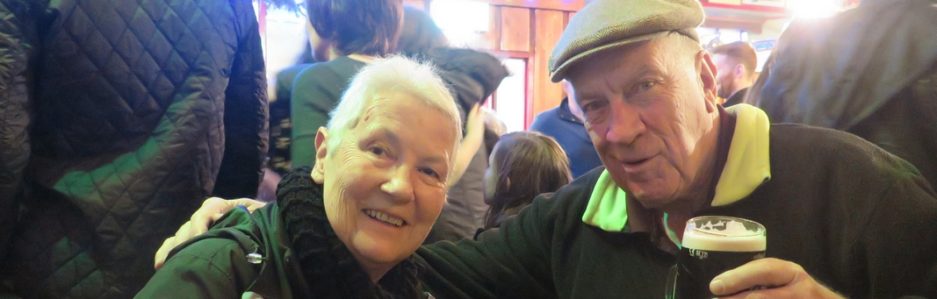
Wednesday was another nice weather day. We took separate walks in the morning. Then it was a quiet day. We stopped at SuperValu to the night’s dinner at home. And we visited the library and both took out some books. Lunch was at a fairly new Dingle restaurant: Flannery’s Fish Box. Another local fisherman family-owned place that catches what they sell, it’s very small. You order at the counter and either do take out or eat at one of the five or six tables. We ate our fish (haddock today) and chips in. It was perfectly prepared! The other food we saw also looked good. Later in the day I drove into town for a Guinness at the Dingle Pub. Dinner was homemade Indian Chicken Rogan Josh. (I call it Josh Groban chicken.) And it was early to bed.
Thursday was a rain day from morning until dinner time. We essentially did nothing. We’re allowed! Reading, tv, naps. For dinner we went to Dingle’s newest restaurant: Land to Sea. It opened just about a month ago. Nice addition to Dingle’s reputation as Ireland’s top foodie town. And we enjoyed our first desserts of the trip.

App: Crispy Calamari 
App: Rabbit Terrine 
Main: Lamb Neck 
Main: Pork Bellies 
Ice Cream 
Champgane Mousse


A Dingle History Lesson
At the top of hill just a short walk from the house is the old Dingle Hospital. In 1850 it opened as a Workhouse, Fever Hospital, School, and Dispensary, The workhouse closed in 1922 and the building became known as St. Elizabeth’s Hospital. It closed for good in 2010 when the new, much smaller West Kerry Community Hospital opened. Since then it has been deserted and has become derelict. I always thought it just begged to be redeveloped as a hotel.


Little did I know that it is a listed building and is unlikely to ever be commercially developed. Locals consider it an important part of the town’s history. And I discovered yesterday that in a field behind the hospital, there is a mass grave site. So it really is a sacred local site inappropriate as a hotel development. We learn something every day.
“The graveyard, once known as the Pauper’s Graveyard, overlooks Dingle town and estimates suggest that anywhere between 7,000 and 10,000 people are buried there.
Those laid to rest in the graveyard include many thousands who died of hunger during the Famine. Its proximity to the old Dingle hospital, which was a workhouse in penal times, means the remains of many who passed away there, are also laid to rest on the hillside. Diseases such as cholera and tuberculous claimed the lives of many more and a number of infants are believed to have been buried there also.
The graveyard, which has been named Reilig Cnoc a’Cairn, has been of great interest to locals and Kerry emigrants as many families have ancestors buried there. However, up until now, it was practically inaccessible.
A long-running local effort, started over 30 years ago by Monsignor Padraig Ó Fiannachta and led in recent years by Fr Jim Sheehy, culminated with the official unveiling on Monday of the improvement works. These include a parking area, an access road leading from Chapel Lane to the site and a small chapel beside the graveyard which has been freed from the covering of furze bushes under which it was hidden for many years.”
Since it was raining, we didn’t visit the grave site, but we will, probably tomorrow.
I’ll be back Saturday night. On Sunday we go to Limerick for the day and night to have a look about and to pick up Bob & Barbara early Monday morning. We have another overnight trip coming up later in the stay.
Oh, and one of my phones died suddenly. Glad we have two. My UK number will be out of service until my replacement arrives from Amazon on Tuesday.


